
In a study published in Nature Cancer, a GPT-4 agent given oncology tools reached correct clinical conclusions 91% of the time across 20 simulated patient cases. It cited the right guideline 75.5% of the time. That is a strong result for a small test, and it points at the real problem: a right answer that cannot be checked is hard to hand to a busy oncologist.
That gap between an answer and a checkable answer is the design question behind agentic AI in oncology practices. Most of the work is deciding which tasks an agent can finish on its own, which it would prepare for a person, and where it would stop and ask.
Short answer: Agentic AI in healthcare is ready for oncology workflows that end in something a person can check, such as a trial shortlist, a tumor board packet, or an authorization status. It is not ready to decide eligibility, choose a regimen, or change the record on its own. Each agent run would end in one of three ways: done, handed to a person with a case packet, or stopped.
What an oncology agent does that a copilot does not
A copilot answers one request at a time: summarize this note, draft this letter. AI agents in healthcare work differently. They take a goal, work toward it in several steps, and call outside tools along the way. A recent review of agentic AI in clinical oncology names the common features as goal-directed behavior, some operational autonomy, and the ability to call external tools within a defined environment.
Take the same task both ways. Ask a copilot to summarize a pasted pathology report, and it does exactly that. Give an agent the goal “prepare this patient for Thursday’s tumor board”, and it would pull the pathology report, the genomic results, and earlier lines of therapy, flag a missing biomarker, and draft a case summary with each line linked to its source. For a plain comparison with scripted automation and standard AI, see our post on RPA, AI and agentic AI.
That reach is what makes agents useful, and it is also why one wrong step early in a run can travel through everything after it. The next section turns that risk into a test for which workflows to hand over.
Five questions that tell you a workflow is ready for an agent
Not every oncology task suits an agent. A workflow would be ready when the answer to all five questions below is yes.
- Can the finish be checked against a source?
A trial shortlist can be checked against the protocol criteria and the chart. A treatment recommendation cannot be checked the same way, because its source is clinical judgment.
- Is a wrong step caught before it leaves the practice?
A misread biomarker early in a run can shape every later step before anyone looks, which is why the check has to sit between the agent and the patient, the payer, or the record.
- Can it reach its tools through an API or a controlled portal?
An agent that works only by imitating a person at a screen is fragile, and its failures are hard to see.
- Can the stop rules be written as tests?
A rule such as “stop when unsure” cannot be tested, while “stop when two sources disagree on stage” can be.
- Is there a local set of cases to test on?
Results from a study do not transfer by default. The Nature Cancer agent was tested on 20 cases, and a practice has its own mix of cancers, record habits, and drug lists.
A workflow that fails the first question would stay with a person. A workflow that fails the others can often be fixed with better tooling, and that is where most of the engineering work sits.
Oncology workflows worth piloting today
Four workflows are good candidates for an agent pilot now. Each one passes the first question because its finish can be checked: a shortlist, a summary, a status, or a list of open slots. The last column says how much proof sits behind each, and the figures follow in the evidence section.
| Workflow | What the agent does | Where it stops | Strength of evidence |
| Trial pre-screening | Reads the chart against open trials and returns a ranked shortlist with the criteria met and missed | At the shortlist. A clinician confirms eligibility | Prospective evaluation, reported by the company that built the system |
| Tumor board preparation | Pulls pathology, genomic results, earlier therapy and imaging reads, flags missing tests and drafts a case summary linked to its sources | At the draft. The board decides, and a person approves the record | Described in the literature, not measured for the preparation step |
| Authorization and claim status follow-up | Checks status, gathers missing documents, and queues the next step | At submission or appeal, which a person signs | Not independently measured in the sources reviewed |
| Patient outreach and scheduling gaps | Spots overdue visits, contacts patients through approved channels and offers open slots | At any reply about symptoms, which goes to a nurse | Described, not measured in oncology |
The authorization and claim rows are covered in depth in our posts on AI prior authorization in oncology and AI in oncology medical billing. Teams planning this kind of task automation can also look at our healthcare automation services.
Where people decide
An agent can prepare almost every step in the table above. Four decisions would stay with a person, because each one changes treatment, eligibility, or the permanent record.
- Trial eligibility. An agent can find a trial and show why a patient may fit. Eligibility rests on judgment about performance status, prior therapy, and what the patient wants, so a clinician would make the call.
- Regimen and dose. Reviews that compare AI systems with tumor board recommendations report weaker agreement in complex or individualized cases. Those are the cases where a regimen choice matters most.
- Symptom triage. A message that mentions fever during chemotherapy or new pain is a clinical event. The agent would route it to a nurse at once instead of answering it.
- Any change to the permanent record. An agent can prepare a change, but a signed-in clinician would make it. Our post on AI EHR integration for oncology covers how that split would work in the chart.
The pattern is the same in each case: the agent prepares, the person decides, and a packet shows what the agent did.
How an agent run ends
Every agent run would end in one of three ways, and rules written before the run starts would decide which one.
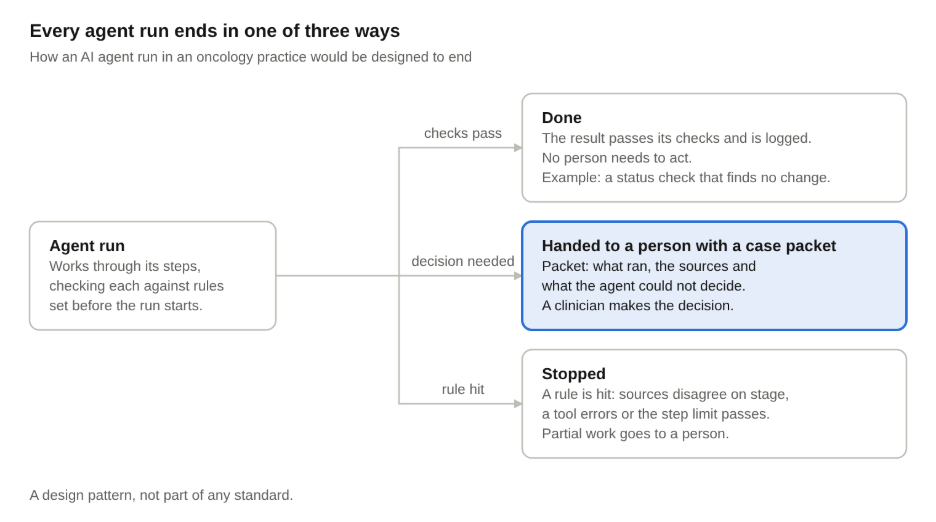
In the diagram, the middle path is the one that sends the case packet to a clinician.
- Done. The result passes its checks, the agent logs what it did, and no person needs to act. A status check that finds nothing changed ends here.
- Handed to a person with a case packet. The agent finishes its preparation and stops at the decision. A trial shortlist and a tumor board summary end here.
- Stopped. A rule is hit, such as two sources that disagree on stage, a tool that returns an error, or a run that passes its step limit. The agent stops, keeps its partial work, and sends it to a person.
The packet is what makes a handoff usable. It would hold three things: what the agent did, the source for every statement, and what it could not decide. A reviewer who has to redo the work to trust the packet has gained little from the agent.
Here is how the three exits would play out in trial pre-screening. The agent reads each patient’s chart and checks it against the open trials.
- Patient one: the pathology report and the oncology note agree on stage, and nearly every criterion can be checked. The run ends with a ranked shortlist and a packet listing each criterion and its source, plus the one item the agent could not confirm, such as a performance status last recorded months ago. A clinician reviews the packet and decides.
- Patient two: the pathology report and the oncology note give different stages, so the stop rule fires. The run ends with no shortlist, and the packet shows both records side by side for a person to resolve.
- Patient three: no open trial is in range. The run is done, the agent logs the search, and no one needs to act.
What the evidence shows, and what it does not
Four sources shape the picture today. Each one is encouraging, and each one comes with a limit worth knowing before a team builds on it.
| Source | What was tested | Result | Read it with this in mind |
| Nature Cancer study of an oncology agent | GPT-4 with oncology tools on 20 simulated multimodal patient cases | Tools used correctly 87.5% of the time, correct clinical conclusions 91.0%, accurate guideline citations 75.5% | Small and simulated. Citations trailed conclusions |
| Prospective trial matching study in the ESMO Real World Data and Digital Oncology journal | A multi-agent system matching 3,804 adults with metastatic cancer to trials during routine care in 2024 | F1 score of 0.82. Matching time fell from about 120 minutes to about 30 minutes per patient. The company describes clinician oversight at the point of decision | Company-reported. Time saved is not the same as better outcomes |
| Systematic review of 29 studies, summarized in an oncology review | AI recommendations compared with tumor board recommendations | Agreement of roughly 62% to 76%, weaker in complex or individualized cases | Measures agreement with a board, not patient outcomes |
| Gartner forecast | Agentic AI projects across industries | Over 40% expected to be canceled by the end of 2027, citing escalating costs, unclear business value, or inadequate risk controls | Not specific to oncology |
What is missing is prospective evidence that agents improve patient or system outcomes. The oncology review reaches the same place: “Current evidence supports augmentation rather than replacement.” That is a good reason to start with workflows whose finish can be checked, and to measure each one in your own practice before widening its reach.
Four controls to set before an agent runs
These controls sit around the agent, not inside the model, so a product team can build and test them like any other part of the system.
- A tool allowlist. The agent would reach only the systems and actions its workflow needs. A trial screening agent has no reason to touch billing.
- Step and time limits. A run that loops or drifts would stop at a set number of steps or minutes and hand over what it has.
- Stop rules written as tests. Each rule, such as two sources disagreeing on stage, would be checked on every run and tested before release against local cases.
- A run log a person can read. Every step, tool call, and source would be recorded in plain language, so a reviewer can see how the packet was built without reading code.
A team that sets these four before the first pilot also gets something useful in return: a clear way to measure the agent against the practice’s own cases, which is the evidence the studies above cannot supply.
How Nalashaa helps
Nalashaa Healthcare Solutions works with healthcare technology vendors and practice teams on the engineering around AI agents, which is where most of the risk and most of the value sit.
- Pick and test the first workflow. We would score your candidate workflows against the five readiness questions and build a local test set before any pilot starts.
- Build the run. We would design the tool allowlist, limits, stop rules, and case packet so every run ends done, handed to a person, or stopped.
- Connect it to your systems. We would wire the agent into the EHR and practice systems through standard interfaces, so it works from the same record your staff already use.
See how we approach this work in our healthcare AI consulting services.
Button: Talk to our team
FAQ
What is agentic AI in healthcare?
Agentic AI in healthcare is software that takes a goal, plans several steps, and uses outside tools to finish it, such as pulling records, checking a status, or drafting a summary. It differs from a copilot, which answers one prompt at a time. In oncology, it suits preparation work whose results a person can check.
Which oncology workflows can an agent handle today?
Four are good candidates to pilot: trial pre-screening, tumor board preparation, authorization and claim status follow-up, and patient outreach and scheduling gaps. In each, one the agent prepares, and a person decides. Proof is strongest for trial matching, and that evidence is company-reported.
Will agents replace nurse navigators or billing staff?
The evidence does not point that way. A recent oncology review concludes that current evidence supports augmentation rather than replacement. Agents take on preparation work such as gathering records, checking statuses, and drafting summaries, which would leave navigators and billing staff more time for the decisions and conversations that need judgment.

Latest posts by Priti Prabha (see all)
- Agentic AI in Healthcare: Where Oncology Agents Stop - November 4, 2026