
Some chemotherapy vials hold more drug than the patient needs. On a Medicare Part B claim, the leftover is reported too, and a claim that does not say whether anything was discarded may come back unprocessable or be audited.
That one detail shows why oncology claims stall. A single visit leaves records in the treatment plan, the drug inventory, the infusion chair, and the chart, and the claim has to agree with all four. When one record is off, the claim is denied, delayed, or paid short, and a short payment is hardest to spot because the claim still looks paid.
Below: where those stalls happen, how AI in medical billing can check a claim, and what to build.
The short answer. Oncology claims stall where drug, administration, and payment records meet: unit and wastage detail on drug lines, payment limits that change each quarter, and coding rules that changed in 2026. AI helps at four checkpoints along the claim, and it works best when every suggestion points back to the record that supports it.
Why an oncology claim is built from many records
Oncology medical billing has more moving parts than most specialties see, because a routine infusion visit produces a claim with several kinds of lines. The drug line carries a J-code, the number of billing units, and the National Drug Code (NDC) of the product that was prepared. Separate lines report the administration, such as the infusion or injection, and an evaluation and management line joins them when the oncologist saw the patient that day. Radiation visits add their own delivery codes.
Each of those lines starts in a different record. The drug line comes from the treatment plan and the pharmacy or inventory system, the administration line from the nursing documentation in the infusion chair, and the visit line from the clinician’s note. The claim is clean only when all of them agree, and two examples show how small a disagreement can be:
- Discarded drug. For Medicare Part B drugs supplied in single-dose containers, the JW modifier reports the amount that was discarded and the JZ modifier states that none was. Medicare has required JZ where nothing was discarded since July 1, 2023. Claim editing began that October, so a single-dose drug line with neither modifier may come back unprocessable.
- Same-day visit and infusion. Billing an evaluation and management visit on the day of chemotherapy administration takes modifier 25 and a distinct, documented service, and infusion nursing time cannot count toward the visit’s time, as the Association of Community Cancer Centers (ACCC) explained in June 2026.
For software teams, the point is that every claim line has an owner system. A check that runs inside one system cannot see a mismatch with another, so the first useful step is to map the source record behind each claim line. Then a reviewer, or a tool, can see where every number came from.
Where oncology claims stall in 2026
Most stalls are not judgment calls, but seams between systems, and 2026 has added a few. In the 2025 State of Claims survey of 250 professionals by Experian Health, reported by HFMA, 41% of organizations said 10% or more of their claims are denied, up from 38% in 2024 and 30% in 2022. The top trigger was missing or inaccurate claim data, named by 50%. The survey covers all specialties, but the cause it names is the one oncology claims share: data that is missing or does not match between records.
The table below lists the stall points that matter most to claim software, from drug-line detail to the 2026 radiation codes.
| Stall point | What goes wrong | Where to look |
| Drug-line detail | Units, wastage or NDC do not match what was prepared and given | Pharmacy or inventory record against the administration record |
| Quarterly payment limits | A rate that was not refreshed pays against last quarter’s number | CMS posted the October 2026 limit files and the NDC to HCPCS crosswalk on September 17, 2026 |
| Underpayments | The claim pays, but short of the expected amount | Payment lines compared with the contracted or limit-based rate |
| 2026 radiation coding | Three external beam codes and one image-guided code replace the old convention for all payers from January 1, 2026, and some programs have not corrected charge routing | Treatment system to billing hand-off for 77402, 77407 and 77412 |
An underpaid claim is the quietest of these, because the payment arrives and the account looks settled. The radiation row comes from the same ACCC article. It also reports that payer policies changed during the first quarter of 2026, so a rule that held in January may not hold in April, which makes oncology billing and coding a moving target for any product that hard-codes its rules.
Almost every row is a data seam, not a judgment error, which makes these the first problems software can close. Authorization gaps are a separate story, covered in our post on AI prior authorization in oncology.
Where AI helps along the claim today
Here is Nalashaa’s view of where AI in medical billing fits, drawn as four checkpoints along the claim. It is our framework, not an industry standard.
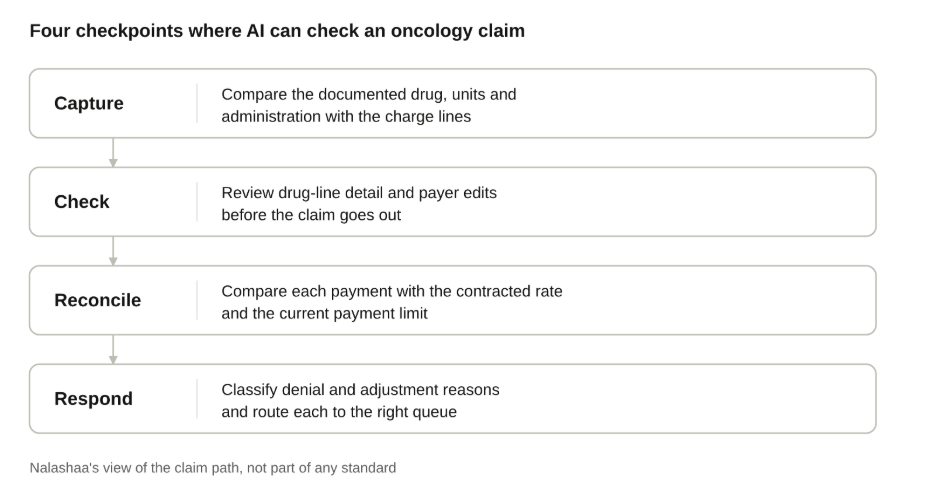
- Capture. Compare what the clinician documented with the charge lines before the visit closes. Ambient documentation tools are already producing structured notes, as covered in our post on ambient AI scribes in US clinics, which gives this checkpoint cleaner input.
- Check. Review drug-line detail and payer edits before billing: units against the amount prepared, the NDC against the J-code, and a JW or JZ modifier where one is required. For a multi-specialty physician group we worked with, checking each claim against a payer-specific rules library before submission came with 18% fewer front-end rejections, as described in our claim submission case study.
- Reconcile. Compare each payment with the contracted rate and the current payment limit, so a short payment surfaces even when the claim shows as paid.
- Respond. Classify denial and adjustment reasons and route each one to the queue of the person who can fix it. Workflow-level automation for claim status checks and claim creation is covered in our post on RPA in healthcare.
Interest in AI is running ahead of use. In the same survey, 67% of finance professionals said AI can improve claims processes, while 14% had applied it to denials. Clarissa Riggins, chief product officer at Experian Health, described the gap this way: “We see this as a paradox where enthusiasm is tempered by operational concerns.”
That gap suggests where to begin. Start at Check and Reconcile, where drug lines and payments are already structured data, then extend to documentation once those checkpoints run well.
Picture a payer that pays one drug a little under its contracted rate for several weeks (an illustration, not a client result). Each claim shows as paid, so nothing prompts a second look. At Reconcile, a tool compares every payment with the contracted rate and the current payment limit, sees the same shortfall repeat, and sends the pattern to a person the same week.
Why explainable claim lines matter on both sides
Insurers and hospitals are disagreeing in public about AI in coding, and each side makes a point worth knowing. The Blue Cross Blue Shield Association (BCBSA) estimates about $942 million in added cost over two years tied to AI coding tools, according to Healthcare Dive, and Luke Chalker of BCBSA said: “If patients are truly sicker, we’d expect to see more treatment.” The American Hospital Association’s fact sheet calls those claims unsubstantiated, says AI works within existing coding rules, and states that human validation remains essential.
Both positions concern hospital diagnosis coding, not oncology drug lines, and this post takes no side on them. The shared lesson still applies to billing software: a claim line that shows the record behind it is easier for every party to review. A payer can see why a unit count is what it is, a coder can confirm it in seconds, and a product team can show its work without a long audit trail.
Because the debate is public, practices and payers are likely to ask where an AI-produced number came from. A product that answers on the claim line itself is easier to adopt and easier to defend in an audit, so build AI to capture what was documented, and show the source record beside every suggested line.
What to build now: a checklist for oncology EHR, practice management and billing tools
For teams building or modernizing claim features, this checklist would be a practical place to begin.
- A drug-line data model. Store the J-code, units, NDC, and discarded amount as structured fields tied to the dose that was prepared, not as free text on the charge.
- A quarterly payment-limit refresh. Load each new Part B payment limit file and the NDC to HCPCS crosswalk when CMS posts it, and keep the effective date on every rate.
- Pre-bill drug-line checks. Compare units with the amount prepared, confirm the NDC matches the J-code, and require JW or JZ on single-dose Part B lines before the claim leaves.
- Charge routing. Map each treatment event to the code set in force on its date of service, and test the 2026 radiation codes end to end.
- Contract-rate reconciliation. Compare every payment line with the contracted or limit-based rate, and queue short payments for review even when the claim is marked paid.
- Remittance reason routing. Sort denial and adjustment reasons by cause and owner, so drug-line, coding, and authorization issues reach different people.
- A source-record link on every AI suggestion. Each suggested claim line would show the drug, administration, or payment record behind it, with its date and the system it came from.
How Nalashaa helps
Our revenue cycle services cover claim management, payment posting and reconciliation, and accounts receivable management, which are the parts of oncology revenue cycle management this checklist touches.
Building claim, payment, or denial workflows into an oncology EHR or billing product? See our revenue cycle services, or connect with us at info@nalashaa.com
FAQ
What are the CPT codes for oncology?
Oncology claims draw on several code families: evaluation and management codes (99202 to 99215), drug administration codes such as 96413, radiation delivery codes such as 77402, 77407, and 77412, and J-codes for drugs. Check the current code set and each payer’s policy before billing.
Is AI replacing medical billing?
No, it is not replacing billing and coding staff. AI prepares and checks claim lines, and those teams review the exceptions. The AHA’s fact sheet states that human validation remains essential, and most oncology claim problems are data mismatches that a person still has to resolve.
How can AI be used in oncology billing?
Teams use it to compare documentation with charge lines, review drug-line detail before billing, compare payments with contracted rates, and sort denial and adjustment reasons into work queues. Each suggestion should show the record behind it.

Latest posts by Priti Prabha (see all)
- AI in Oncology Medical Billing: Fixing Claims That Stall - October 16, 2026