
An ePrescribing integration often looks straightforward at the outset, since connecting to a network, sending a NewRx message, and confirming that the pharmacy received it can feel like the whole job. The real complexity tends to show up afterward, when a pharmacy sends back a change request, a benefit check comes back denied, a controlled substance needs a second signer, or a duplicate message appears after a timeout. None of that looks like an API problem on the whiteboard, but this is where eRx integrations most often need extra engineering time beyond what teams originally planned for. This guide walks through the scenarios that surface once a team moves past the pilot, and how to architect around them before they become release blockers.
Why ePrescribing Is Not a Normal API Integration
A prescription isn’t a request-response pair. Surescripts’ own description of e-prescribing breaks the process into distinct transaction types rather than one “send prescription” call, covering new prescriptions along with everything that follows: fills, changes, transfers, renewals, cancellations. That’s a step further than the core eRx workflow covered previously, which walks through the basic prescriber-to-pharmacy path this article assumes as background. Epic’s public NCPDP interface catalog shows the same thing from inside a major EHR, where prescription transmission, incoming pharmacy messages, medication history, formulary and benefit checks, and prior authorization are all separate interfaces rather than one bundled feature.
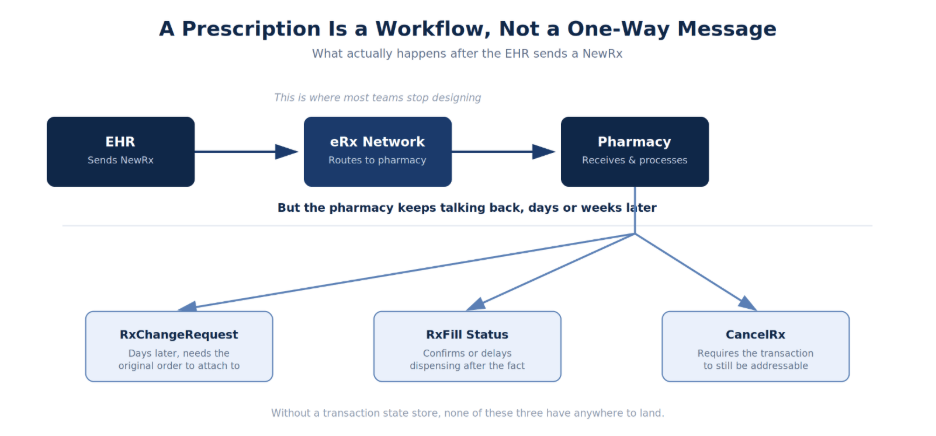
A prescription’s life doesn’t end when the message leaves the EHR. It can trigger a renewal request, a change request, or a fill-status update days or weeks later, and each of those needs to find its way back to the right patient and the right medication order. When the data model has no concept of an open transaction that can still change state, a pharmacy-initiated change request has nowhere to attach itself. That gap usually surfaces the first time a pharmacy operations team calls to ask why their change request seems to have vanished, at which point the fix gets bolted onto a medication record that was never designed to hold it.
Map the End-to-End eRx Architecture Before You Build
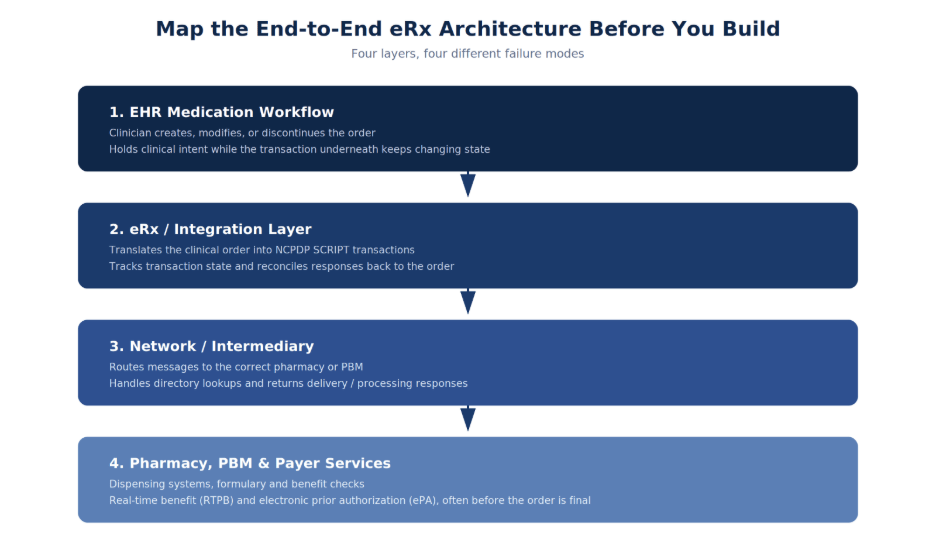
It helps to think of the system in four layers, because each one fails differently and each one needs its own design attention.
The EHR’s medication workflow is where the clinician creates, modifies, or discontinues an order, and it needs to hold that clinical intent even while the underlying transaction is still moving. Below that sits the eRx integration layer, which translates the clinical order into NCPDP SCRIPT transactions and tracks the state of each one as responses come back. The network or intermediary, whether that’s Surescripts or a platform like DrFirst, routes those messages to the right pharmacy or PBM, runs directory lookups, and returns delivery confirmations that the integration layer has to interpret correctly. And at the far end sit the pharmacy, PBM, and payer services, which increasingly include real-time benefit and electronic prior authorization checks that respond before a prescription is even finalized.
Mapping these four layers before writing integration code gives the team a shared vocabulary for where a given failure belongs. That vocabulary matters once the harder edge cases below start showing up in code review.
The Integration Challenges That Create the Most Rework
Transaction scope and asynchronous state management.
Treating a prescription as fire-and-forget is the single biggest source of rework on these projects. A NewRx can be followed by an RxChangeRequest, a fill-status update, or a CancelRx, and each one needs to reference the original transaction and medication order. Skip the transaction state store at the start, and the retrofit later is expensive, because by then the medication data model, the clinician-facing status UI, and the support tooling have all been built around a binary “sent or not sent” assumption that has no room for what happens in between.
Patient, prescriber, pharmacy, and benefit identity.
Every transaction depends on matching the right patient, prescriber, and pharmacy across systems that don’t share a common identifier. A near-match on demographics, an NPI that resolves to the wrong practice location, or a pharmacy that’s changed names since the directory was last synced can each misroute a prescription without throwing an error. This deserves its own design, not a lookup buried inside a transaction handler, since a demo environment with clean test data will never surface it.
Drug identifiers, SIGs, quantities, and units.
Medication data rarely arrives clean. SIG instructions, quantities, days’ supply, and unit conventions vary across prescribing and pharmacy systems, and small mismatches generate clarification calls that slow down fulfillment. A normalization layer that maps incoming drug data to one consistent internal representation keeps that ambiguity from landing on the pharmacist’s desk. It’s also where a product team decides how much free-text SIG interpretation to accept versus how much to push back to the clinician for structured entry, a decision that shapes both pharmacist workload and how clean the audit trail looks later.
SCRIPT 2023011 migration and certification dependencies.
CMS has adopted NCPDP SCRIPT v2023011 as the required Part D e-prescribing standard beginning January 1, 2028, and NCPDP’s standards guidance names SCRIPT 2023011 alongside RTPB v13 and Formulary & Benefit v60 as the near-term milestones to plan around. For teams that need the underlying standards explained first, this breakdown of NCPDP SCRIPT and EPCS is a useful starting point. ASTP/ONC’s current electronic-prescribing test method already reflects SCRIPT 2023011 and the certification changes under HTI-4. Teams that hard-code version-specific field structures directly into the data model, instead of isolating version-dependent parsing into its own layer, usually find the eventual migration touches far more of the codebase than they budgeted for.
EPCS identity, signing, audit, and controlled-substance workflows.
Electronic prescribing of controlled substances isn’t a checkbox layered on top of standard eRx. The DEA’s EPCS requirements cover identity proofing, two-factor signing, and audit logging in specific detail, and this guide to key security measures for ePrescribing covers the broader security posture this fits into. Teams that treat EPCS as an afterthought usually discover the gap when a clinician tries to prescribe a controlled substance and the workflow simply has no path for it, at which point identity proofing, signing credentials, and audit logging all need to be retrofitted into a flow that was never built to hold them.
RTPB, ePA, formulary, and medication-history dependencies.
Real-time prescription benefit, electronic prior authorization, formulary checks, and medication history are separate services that plug into the prescribing workflow at specific moments, often before the prescription is finalized. Design the order screen without accounting for where those responses need to appear, and the UX rework shows up fast: a clinician staring at a benefit check that never returns needs a defined fallback, not a spinner with no exit.
Retries, duplicate messages, timeouts, and observability.
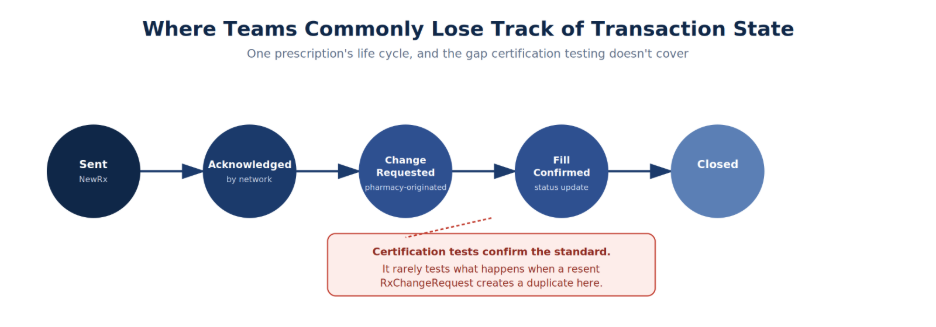
Networks and pharmacy systems occasionally resend messages or time out, and without idempotency keys and a clear retry policy, a resent RxChangeRequest can quietly create a duplicate order. A support team with no visibility into transaction state has no way to diagnose it. This is usually the first gap to surface in production, because it depends on real network conditions and real pharmacy behavior that a certification sandbox doesn’t fully reproduce.
Not sure where your architecture has this kind of gap?
An architecture review can surface transaction, identity, and certification dependencies before they turn into release blockers. The Product Engineering team here works with EHR and HIT vendors on exactly these integration layers.
A Safer Implementation Sequence for EHR Product Teams
Start by listing every prescribing workflow the product needs to support, including renewals, changes, cancellations, and controlled substances, before choosing which interfaces to build. Working from the workflow list rather than the API documentation is what surfaces a dependency like EPCS or RTPB early enough to design for it, instead of discovering it mid-build.
Next, decide where transaction state lives, which service owns updates to it, and how the clinical medication order stays synchronized with the transaction as it moves through the network. That decision is far cheaper to make on a whiteboard than after the first pharmacy-initiated message has nowhere to land.
With state decided, build the normalization and identity-matching logic for drug data, patients, prescribers, and pharmacies as a shared service rather than duplicating ad hoc matching inside each transaction handler. Only then move to integration, certification, and regression testing, followed by a real pilot. Certification confirms conformance to the standard. It says nothing about how the system handles a real pharmacy’s quirks, a slow benefit response, or a malformed message, which is exactly why the pilot phase comes after certification rather than replacing it.
Testing, Certification, and Production Readiness
Passing ASTP/ONC’s certification test method or a network’s certification tester proves the system correctly implements the specified transactions. It doesn’t exercise partial fills, pharmacy-to-pharmacy transfers, or a pharmacy system responding slower than the test harness expects, all of which show up once real trading partners are connected.
Most teams thoroughly test the outbound NewRx path and under-test everything that comes back: change requests, denials, cancellations, and error responses. Building test cases around pharmacy-originated messages, not just EHR-initiated ones, is what catches the gaps that certification alone won’t. Production observability should make it possible to see the state of any transaction, find where a message stalled, and replay or reprocess it without touching the underlying data by hand. Without that visibility, a support ticket about a “missing prescription” can eat an afternoon instead of a few minutes.
What the 2027-2028 Standards Deadlines Change
CMS’s compliance timeline places NCPDP Real-Time Prescription Benefit v13 and Formulary & Benefit v60 requirements for applicable Medicare Part D workflows beginning January 1, 2027. Teams building a 2026 roadmap should treat that as a near-term dependency rather than something to revisit later.
NCPDP SCRIPT v2023011 becomes the required Part D e-prescribing standard on January 1, 2028. Given how much lead time a version migration usually needs across certification, testing, and pharmacy trading-partner coordination, the planning window for that migration should open well before the deadline year, not during it.
ASTP/ONC’s HTI-4 certification changes move certified health IT toward SCRIPT 2023011 and RTPB, with relevant 2027 implementation obligations for developers of certified health IT, and RTPB becomes part of the Base EHR definition beginning in 2028. Every architecture decision in this article ties directly back to that certification timeline, not just to general product strategy.
ePrescribing Integration Checklist for EHR Vendors
| Area | Checklist item |
| Transaction design | Transaction state store defined and shared across all message types |
| Transaction design | Idempotency keys implemented for retries and duplicate messages |
| Identity | Patient, prescriber, and pharmacy matching logic centralized, not duplicated per handler |
| Drug data | Normalization layer for SIGs, quantities, units, and drug identifiers |
| EPCS | Identity proofing, two-factor signing, and audit logging designed in from the start |
| Standards | SCRIPT 2023011 migration path scoped against the January 1, 2028 deadline |
| Standards | RTPB v13 and F&B v60 dependencies scoped against the January 1, 2027 deadline |
| Workflow | RTPB, ePA, formulary, and medication-history integration points defined in the order workflow |
| Testing | Negative-path and pharmacy-originated message test cases included, not just outbound NewRx |
| Testing | Certification testing treated as a milestone, not a substitute for regression testing |
| Production | Monitoring and replay procedures defined for stalled or failed transactions |
| Production | Escalation path defined for support teams diagnosing a “missing prescription” report |
Conclusion: Build for the Workflow, Not Just the Message
Every challenge here traces back to one root cause: treating ePrescribing as a single message instead of an ongoing, multi-party workflow whose state keeps changing after it leaves the EHR. Teams that map the workflow, the identity and terminology dependencies, and the standards timeline before writing integration code spend far less time reworking the architecture after launch.
Treating the integration as a complete medication workflow, not simply an outbound interface, makes it easier to test, migrate, and support over time. Nalashaa’s Product Engineering and Healthcare Interoperability teams help EHR and HIT vendors map these boundaries before development or modernization begins.
Frequently Asked Questions
Does FHIR replace NCPDP SCRIPT for ePrescribing?
No. HL7’s MedicationRequest resource represents a medication order within the clinical information model, while NCPDP SCRIPT remains the standard for the actual prescription exchange between prescribers, networks, and pharmacies. The two solve different parts of the medication workflow rather than one replacing the other.
Does an EHR need Surescripts certification?
Connecting the Surescripts network requires passing certification testing for the relevant transaction types. That certification confirms conformance to the network’s requirements, but it’s one milestone in a broader testing plan, not the final step before production.
What changes with SCRIPT 2023011?
CMS has adopted NCPDP SCRIPT v2023011 as the required Part D e-prescribing standard beginning January 1, 2028, with related certification changes already reflected in ASTP/ONC’s current test method under HTI-4. Scoping the migration path now avoids a scramble in the deadline year.
How long should eRx integration testing cover?
Testing should go past certification conformance to include negative paths, pharmacy-originated messages, retries and duplicates, and production-style monitoring and replay scenarios. A realistic testing window leaves room for pilot-phase feedback from real pharmacy trading partners, not just the certification test suite.

Latest posts by Priti Prabha (see all)
- RPA in Healthcare: 5 Workflows to Automate First - October 6, 2026