
The clinical note is the official story of a patient’s care. Every code, every claim, every quality score, and every risk-adjustment calculation is built on what that note says. When the documentation is complete and specific, the rest of the revenue cycle runs cleanly. When the note leaves out a detail the clinician clearly knew, the record understates the care that was given, and the codes, payments, and quality numbers follow it down.
Clinical documentation improvement is the work of closing that gap. It is a practical, well-established discipline, and it is one of the highest-leverage things a provider organization can invest in. This guide walks through what CDI is, how a program runs day to day, the numbers that tell you it is working, and where AI now takes real weight off the team. You will find a short plan at the end that you can start this quarter.
What is Clinical Documentation Improvement
Clinical documentation improvement, or CDI, is the structured practice of reviewing clinical documentation and working with clinicians to make the record accurate, complete, and specific. Many teams now call it clinical documentation integrity, which keeps the same goal with a sharper focus on accuracy rather than simply adding detail. The discipline has its own professional community and standards, represented by bodies such as ACDIS. The person who does this work is a clinical documentation improvement specialist, often a nurse or a coder by background, who reads charts with both a clinical eye and a coding eye.
The aim is simple to state. The record should reflect exactly how sick the patient was and exactly what was done for them, in a language that supports the correct ICD-10-CM codes, the right DRG, and accurate quality reporting. CDI is how a provider organization keeps the written record and the real care in step.
Why Clinical Documentation Improvement Matters
Good documentation pays off in several directions at once.
It supports accurate coding and appropriate reimbursement. Specific documentation lets coders assign the codes and DRG that match the care delivered, so the organization is paid correctly for the work it did.
It strengthens quality and risk scores. Measures tied to value-based care and risk adjustment, including hierarchical condition categories, depend on documented conditions. A condition that was treated but not clearly recorded does not count.
It reduces denials and rework. Clean, complete records give payers fewer reasons to send a claim back, which means less back-and-forth and faster payment.
It improves the data underneath everything else. Accurate documentation feeds cleaner reporting, and that is what makes healthcare data analytics worth trusting when leaders use it to make decisions.
The payoff is well documented. A peer-reviewed study in the Journal of Vascular Surgery found that a physician-led CDI initiative raised both the case mix index and the contribution margin, and the same pattern holds across specialties. Case mix index is the usual yardstick here, since it reflects the documented complexity of the patients you treat. Reported gains are real: one regional medical center lifted its case mix index by 20 percent and captured over $558,000 in additional revenue within a few months of tightening its documentation.
None of this requires a dramatic overhaul. It comes from steady, careful attention to the record, applied where it matters most.
How a CDI Program Works
A CDI program runs on a straightforward loop that repeats across many charts.
Review the chart.
Specialists review documentation either concurrently, while the patient is still in-house, or retrospectively, shortly after discharge. Concurrent review is the more powerful of the two, because the care team can still clarify the record while the details are fresh.
Spot the gap.
The specialist reads for places where the record is unclear, incomplete, or missing the specificity that coding needs: a diagnosis implied by the labs or medications but not stated, or a condition recorded without the detail a code requires.
Query the clinician.
When something is missing, the specialist sends an open, non-leading question that invites the clinician to clarify what they observed and treated. A good query never steers them toward a particular diagnosis for financial reasons.
Clarify and update.
The clinician responds, and the record is updated to reflect their answer.
Assign the codes.
The coder assigns the codes, and the DRG from the corrected documentation, and the loop closes
Here is the loop in miniature. A note documents pneumonia, but the labs, the antibiotics, and the vital signs point to sepsis that no one wrote down. The specialist sees the gap and sends a query asking the physician to clarify the clinical picture. The physician confirms sepsis, the record is updated, and the encounter now maps to a DRG that reflects how sick the patient was. Nothing was invented. The documentation simply caught up with the care.
The people who make this work are the CDI specialist, a physician advisor who champions the program and helps with clinical peer conversations, and the coding team the specialist partners with. A healthy clinical documentation improvement program keeps these roles in close, everyday contact rather than treating documentation, querying, and coding as separate stages.
The Metrics that Show a CDI program is Working
You can tell whether a program is healthy by watching a handful of numbers.
- Query rate. How often does documentation need clarification?
- Query response and agreement rate. Whether clinicians are engaging with those queries, and how often the record ends up changing.
- Case mix index. The documented complexity of the patients treated. A rising index often signals that real severity is finally being captured.
- CC and MCC capture rates. How well complications and comorbidities are documented.
- Denial rate and denials overturned on appeal. How well does the record hold up with payers?
- Time from discharge to final code. How quickly does the loop close?
Baseline these before you change anything. Numbers you did not measure at the start are hard to improve with confidence later.
Where AI helps in Clinical Documentation Improvement
This is where a modern CDI program gets a real lift. AI does not take the specialist’s place. It clears the busy work so the specialist can spend their time on judgment.
It surfaces likely gaps.
Natural language processing reads the full note and flags conditions that the labs, medications, or vital signs suggest, but the documentation does not yet state. The specialist sees the possible gap instead of hunting for it.
It prioritizes the right charts.
Instead of reviewing charts in the order they arrive, the team can work the ones with the most clinical or financial weight first, because the system ranks them.
It drafts query language for review.
AI can propose a clear, compliant, non-leading query that the specialist reads, adjusts, and approves before it goes to the clinician. The specialist stays in control of every word that reaches a physician.
It spots patterns worth teaching.
Across many charts, the system can show which documentation gaps recur and with which teams, which turn into focused, friendly clinician education.
Much of this rides on the same foundations as any good healthcare AI: clean document capture and solid EHR integration, which is exactly the kind of healthcare automation that lets these prompts appear inside the workflow instead of in a separate tool.
Where the Specialist Stays Essential
AI proposes, and the specialist decides. That balance is what keeps a CDI program both effective and compliant.
The clinician’s judgment cannot be automated. Only the treating physician can confirm what a patient had and what was done about it. Query integrity also stays firmly in human hands. Queries must be open and non-leading, and they must follow compliant query practice, the standard that AHIMA and ACDIS jointly set out. A person signs off on the final record, and a person handles the complex and unusual cases where the pattern does not fit. Seen this way, AI is a strong assistant to a skilled team, and the specialist remains the professional who owns the outcome.
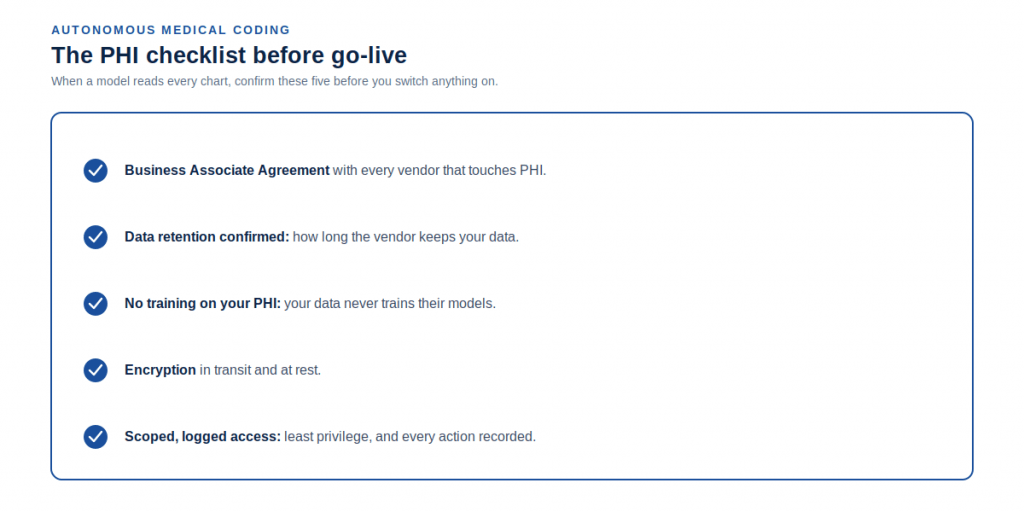
One practical question belongs here, too. Because the AI reads the full chart, it is handling protected health information, so confirm where that data goes before you switch anything on. Any vendor that processes PHI should be covered by a Business Associate Agreement; your data should not be used to train someone else’s model, and access should be encrypted and logged. It is a quick check that saves a difficult conversation later.
How to Start or Strengthen a CDI Program this Quarter
You do not need to solve everything at once. This sequence works whether you are standing up a new program or sharpening an existing one.
1. Pick one focus area. Choose a single service line or DRG family where better documentation would clearly help and start there.
2. Baseline your metrics. Capture query rate, response and agreement rates, case mix index, CC and MCC capture, and denial rate before you make changes.
3. Set a clean query workflow. Agree on how queries are written, reviewed, and tracked, and make non-leading, compliant language by the default.
4. Add AI where it removes repetition. Let the system surface gaps, rank charts, and draft queries for review, and keep your specialists focused on judgment.
5. Measure, then expand. Once the focus area holds its targets on your own data, add the next service line. Grow by evidence, not by ambition.
Each step is small on its own, and together they compound into a program that pays for itself.
Frequently asked questions
What is clinical documentation improvement (CDI)?
CDI is the practice of reviewing clinical documentation and working with clinicians to make the record accurate, complete, and specific enough to support correct codes and quality reporting. CDI stands for clinical documentation improvement, and many teams now call it clinical documentation integrity.
What does a clinical documentation improvement specialist do?
A CDI specialist reviews charts with both a clinical and a coding eye, spots gaps or unclear documentation, and sends non-leading queries asking the clinician to clarify. They work closely with physicians and coders to keep the record accurate.
What is the difference between clinical documentation improvement and clinical documentation integrity?
They describe the same work. Integrity is the newer term, and it emphasizes accuracy and completeness rather than simply adding more detail. The goals, roles, and workflows are the same.
How do you measure whether a CDI program is working?
Watch query rate, query response and agreement rates, case mix index, CC and MCC capture, denial rate and overturns, and the time from discharge to final code. Baseline them first, then track the trend.
Does AI replace CDI specialists?
No. AI surfaces likely gaps, ranks charts by impact, and drafts query language, but the specialist reviews and approves every query, and the clinician confirms the clinical facts. AI removes the repetitive work so specialists can focus on judgment.
Is CDI only for inpatient care?
No. CDI began in the inpatient setting, where DRGs make documentation especially high-stakes, but outpatient and clinic-based CDI are growing quickly, especially risk adjustment and quality reporting.
Where to go from here
If you are building or strengthening CDI on your own platform or in your revenue cycle, the rewarding part is usually the design: compliant query workflows, clean EHR integration, and AI that helps your specialists rather than working around them. That is the work Nalashaa’s healthcare AI consulting team does with providers and health IT teams every day.
Bring us the service line you would focus on first, and we will help you shape a practical, integration-ready CDI approach around it.

Latest posts by Priti Prabha (see all)
- The Architecture Behind Modern ePrescribing Systems - September 8, 2026