
Payers denied about 11.8 percent of claims on first submission in 2024, up from 10.2 percent in 2020, and coding is one of the biggest reasons a claim gets paid or sent back. Medical coding is one of the most skilled jobs in the revenue cycle: translating a clinical note into clean ICD-10-CM and CPT codes takes clinical understanding, coding expertise, and a careful eye for the payer rules that decide whether a claim is paid. It is also expensive work at scale. Administrative work is estimated to consume 20 to 25 percent of U.S. health spending, with billing and coding among the biggest drivers. Most medical groups still automate 40 percent or less of their revenue cycle, so a large share of that work is still done by hand. So teams keep asking a reasonable question: can technology take the routine, high-volume work off the plate so expert coders can focus on the cases that genuinely need them?
Autonomous medical coding is one of the most promising answers to that question in 2026. Used well, it gives skilled coders their time back, speeds up the reimbursement cycle, and can make the whole process more consistent and more auditable. It is also a genuinely new capability, and like any new capability, it rewards teams who understand it before they deploy it.
This piece walks through what autonomous coding really is, how it differs from the computer-assisted coding you may already run, how a note becomes a code, where the patient data goes, and where a human stays in the loop. At the end, you will find a short, practical roadmap you can start this quarter.
What is Autonomous Medical Coding?
Autonomous medical coding is software that reads clinical documentation and assigns final, billable diagnosis and procedure codes without a human touching every chart. High-confidence encounters get coded and released automatically. Anything the system is unsure about, or anything complex, gets routed to a human coder.
The word that earns its keep is autonomous, not automated. Plenty of tools automate a step or two. An autonomous system is built to own the outcome for a defined slice of your encounters, usually the high-volume, well-structured ones, and to know when it should hand a chart back to a person. That self-awareness, expressed as a confidence score on every code, is the whole difference between real autonomy and a faster version of the old process.
Computer-assisted coding vs. autonomous coding
Think of a spectrum, not a switch.
Think of a spectrum, not a switch. Computer-assisted coding and autonomous coding sit at two points along it, and the difference comes down to three things.
| Computer-assisted coding (CAC) | Autonomous coding | |
| Who reviews charts | A coder confirms, corrects, or rejects the codes on every chart | Coders review only the exceptions the system escalates |
| Where the decision boundary sits | The system suggests; a human decides on every encounter | The system finalizes high-confidence codes and routes low-confidence or complex charts to a human |
| Risk profile | Lower risk, since a person is on every claim, though the productivity gain is capped by human review | Bigger gain on the right case mix, with risk concentrated in model quality, thresholds, and the exception workflow |
Neither one is automatically the right answer. CAC is a safe, well-understood way to lift productivity while keeping a person on every encounter. Autonomous coding delivers bigger gains on the right case mix, but it concentrates responsibility on the quality of the model, the confidence thresholds you set, and the exception workflow you build. The organizations that succeed almost never flip the whole revenue cycle at once. They expand autonomy gradually, by encounter type, by specialty, by confidence level, and they let the two approaches run side by side.
How AI turns a clinical note into a billable code
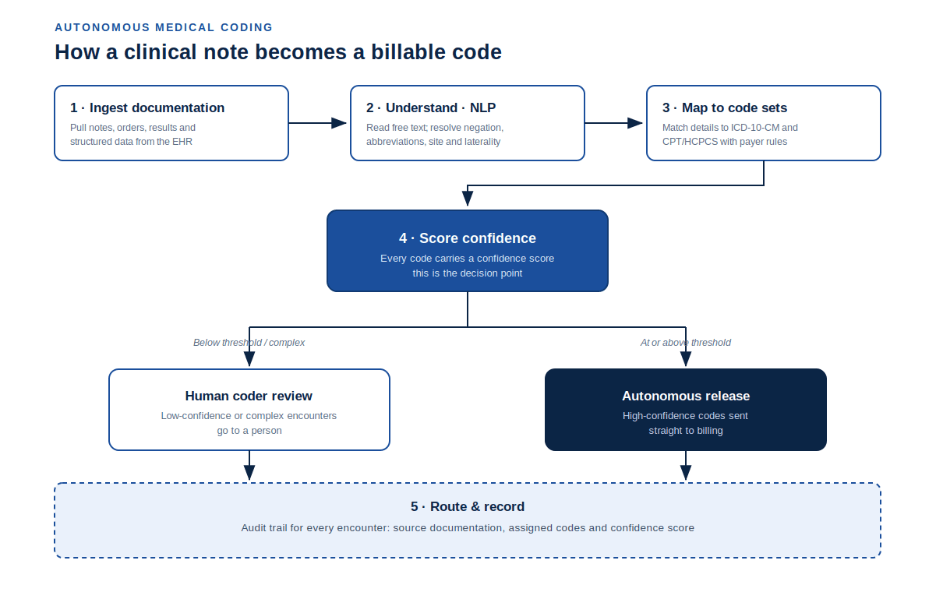
Turning a note into a code is a pipeline, not a single leap. A typical autonomous system moves through five stages.
- Ingest the documentation: It pulls the relevant notes, orders, results, and structured data for an encounter from the EHR.
- Understand the language: Natural language processing reads the free text, resolves abbreviations and negations, the difference between “rule out sepsis” and “sepsis,” and extracts the clinical detail that matters: diagnoses, procedures, site, severity, laterality.
- Map to code sets: Those details are matched to the correct ICD-10-CM and CPT/HCPCS codes, applying coding rules, edits, and payer-specific logic.
- Score confidence: Every proposed code carries a confidence score. This is the decision point. Above your threshold, the code is eligible for autonomous release. Below, the encounter is flagged for review.
- Route and record: Confident encounters flow to billing. Flagged ones go to a coder. Every decision is written to an audit trail.
That last step is the one teams underestimate and can never skip. The audit trail- what the system saw, what it assigned, and how confident it was- is what makes an autonomous decision reviewable when a payer asks and improvable when a denial comes back.
| Example: the confidence score in action A routine emergency department visit arrives with a clean, well-structured note. The model reads it, assigns the codes, scores the encounter at 0.94, and releases it straight to billing with no human touch. The next chart is an inpatient stay with three interacting comorbidities and a sequencing question. There, the model’s confidence falls to 0.61, below the release threshold, so it routes the chart to a coder with its suggested codes and its reasoning attached. Same system, same day, two very different paths. That split is the point of autonomy done well. |
Where Accuracy Holds, and Where it does not
This is where enthusiasm has to meet honesty. Vendors and industry analyses report strong results for AI-driven coding, often first-pass accuracy in the mid-90s on well-structured encounters and coding-time reductions in the range of 40 percent, with some reporting sizable jumps in first-pass clean-claim rates after rollout. Treat those as directional vendor figures rather than guarantees, because the conditions behind them are rarely your conditions.
The number that matters is not the blended one. Accuracy is uneven across case types. Structured, high-volume encounters like outpatient radiology and emergency department visits are where AI is strongest, because the documentation is patterned, and the code logic is tighter. Complex inpatient cases, with layered comorbidities and sequencing rules, are harder, and accuracy on them runs lower. That is why most organizations pilot autonomous coding on part of their volume rather than switching everything at once.
So the practical rule is simple. Judge accuracy by case type, never as one headline percentage, and set your autonomous-versus-review boundary from that. A figure that looks excellent on ED visits can quietly mislead you about your inpatient book. Before you trust any blended average, audit a sample of around 100 charts for each encounter type, and let what you find on your own charts, not the vendor’s headline, set your thresholds.
Keeping a Qualified Human in the Loop
Autonomous does not mean unattended, and this is where a technology choice becomes a compliance choice. CMS billing rules and AHIMA’s Standards of Ethical Coding both assume a qualified professional stands behind the codes on a claim. Autonomous coding does not remove that expectation. It changes where humans spend their attention, from every chart to exceptions and oversight.
The profession has been clear about how to do this well. AHIMA, in its work on autonomous coding, describes the technology as a way to code high-volume charts in seconds and support coders rather than replace them, and it recommends that organizations audit these systems regularly to keep quality high and to keep pace with changing payer and regulatory requirements. In practice, that means three things:
- A defined review path for low-confidence and high-risk charts.
- Periodic audits of what the system released, checked against a certified coder’s judgment.
- Clear ownership of the outcome.
Built this way, autonomous coding becomes a compliance asset rather than a risk. It is more consistent, more traceable, and more auditable than a purely manual process, because every decision it makes is recorded and reviewable. The teams that get the most from it plan that oversight in from the start, so it is part of the design rather than something bolted on after a payer raises a question.
Where does the PHI go
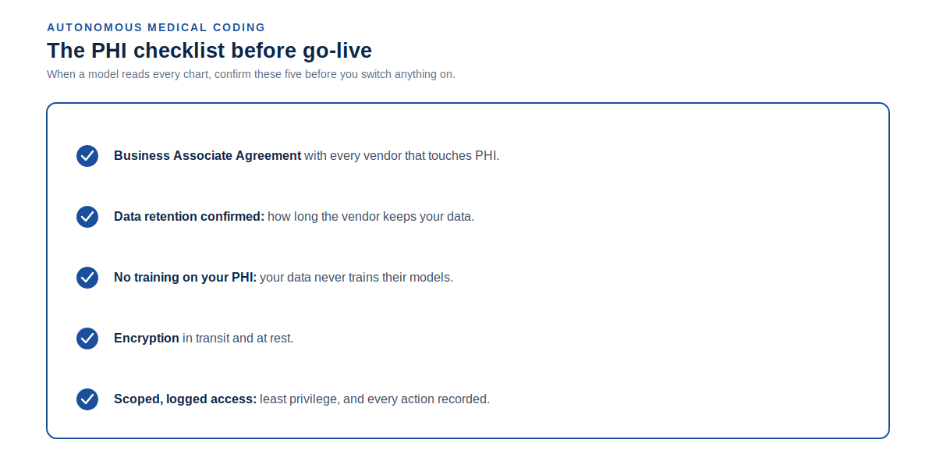
There is one question a compliance officer will ask before any of this goes live, and the article would be incomplete without it. When a model reads every chart, where does the clinical note actually go? If the coding runs on a third-party or hosted service, protected health information is leaving your environment, and that changes what you need to check. Confirm there is a Business Associate Agreement with any vendor that touches PHI. Ask how long they retain the data, and whether your PHI is used to train their models, which for most providers should be a firm no. Check that data is encrypted in transit and at rest, and that access is scoped and logged. None of this blocks autonomous coding. It decides which vendors and deployment models you can responsibly use, and it is far cheaper to settle before go-live than after.
2026 Context: Denials and the Road to ICD-11
Two pressures make this timely. The first is denials, which have become a steady drain. Payers initially denied about 11.8 percent of claims in 2024, up from 10.2 percent in 2020, according to Kodiak Two pressures make this timely. The first is denials, and coding sits right at the heart of them. Reworking each denied claim costs about $25 or more in staff time, and Change Healthcare’s analysis finds that nearly a quarter of all denials are never recovered. The encouraging part is that most denials are preventable, roughly 86 percent by that same analysis, and more consistent coding is one of the clearest ways to prevent them, which is exactly what a well-run autonomous or assisted coding process delivers.
The second pressure is the eventual move to ICD-11. Here, the honest position is that no U.S. compliance date has been set as of 2026. ICD-10-CM remains the required code set for claims, and the bodies that would set a timeline, the National Committee on Vital and Health Statistics and the CDC’s National Center for Health Statistics, are still in research and planning. Based on the decade-long ICD-9 to ICD-10 transition, any eventual switch would likely span several years once it formally begins.
When that transition does arrive, AI could help. A model that already maps documentation to codes is well placed to translate between code sets and soften the productivity dip that a major changeover usually brings. That is a reason to build on a flexible, well-governed foundation now, not a reason to plan around a date that does not yet exist. Confirm current requirements against CMS and NCHS directly before you build any plan around ICD-11.
Your action plan for this quarter
If you take one thing from this article, take this sequence. It is the path that consistently works, whether you run a revenue cycle or build the platform others code on.
- Pick one high-accuracy encounter type to pilot. Start where AI is strongest, such as outpatient radiology or ED visits. Resist the urge to boil the ocean.
- Baseline four numbers before you change anything. Coding productivity, first-pass clean-claim rate, denial rate, and days in A/R. You cannot prove value you did not measure at the start.
- Set the confidence threshold and the exception workflow together. Decide the score above which codes release automatically and below which they route to a coder, and give those flagged charts to your best coders, not your spare capacity. Where the boundary sits and who handles the exceptions is one decision, and it is where autonomy earns trust. Write down why, and revisit it monthly.
- Turn on the audit trail from the first encounter. Capture source documentation, assigned codes, and confidence for every decision, in an auditable form aligned with AHIMA guidance. It is far cheaper to build in than to retrofit.
- Feed denials back in, then expand by evidence. Payer responses are free signal, and a system that learns from what actually gets paid keeps getting better. Add a new encounter type only after the current one holds its accuracy and clean-claim targets on your own data.
The difference between a coding tool that dazzles in a demo and one that survives a payer audit is not the model. It is the architecture, the integration into your EHR and billing stack, and the governance around thresholds, data handling, and audit trails. That is unglamorous engineering work, and it is where most of the real value and most of the real risk live
Frequently asked questions
What is autonomous medical coding?
AI that reads clinical documentation and assigns billable ICD and CPT codes end to end, releasing high-confidence codes automatically and routing low-confidence or complex cases to human coders.
How is it different from computer-assisted coding (CAC)?
CAC suggests codes for a human to confirm on every chart. Autonomous coding finalizes the codes it is confident about and escalates only the exceptions. It is a spectrum, not a switch, and most organizations run both.
How accurate is AI medical coding?
Vendors report high accuracy, often the mid-90s on structured, high-volume encounters, with lower accuracy on complex inpatient cases. Treat vendor figures as directional and validate against your own data by case type rather than trusting one blended number.
Is autonomous coding compliant with CMS?
It can be, if a qualified professional oversees the work and the workflow and documentation show it. CMS rules and AHIMA’s Standards of Ethical Coding assume human accountability, so a defined review path for exceptions, regular audits, and a complete audit trail are essential.
Where does the patient data go?
If coding runs on a third-party or hosted service, PHI leaves your environment. Confirm a Business Associate Agreement, check data retention and whether your PHI trains the vendor’s models, and require encryption and scoped, logged access.
Does it help with the ICD-11 transition?
No U.S. compliance date has been set as of 2026, and ICD-10-CM remains the required code set. When a transition eventually comes, AI that already maps documentation to codes could help translate between code sets. Confirm current requirements with CMS and NCHS before planning.
Where to go from here
If you are weighing autonomous or AI-assisted coding for your platform or revenue cycle, the hard part is rarely the AI. It is setting defensible thresholds, handling PHI responsibly, integrating cleanly with your EHR and billing systems, and building an audit trail that holds up when a payer looks closely. That is the work Nalashaa’s healthcare AI consulting team does with providers and health IT teams every day.
Bring us the encounter type you would pilot first, and we will help you scope a compliant, integration-ready approach around it.

Latest posts by Priti Prabha (see all)
- RPA in Healthcare: 5 Workflows to Automate First - October 6, 2026