
Most orthopedic procedures are not part of the WISeR model. Joint replacement is not on the list. The services that are on it, such as knee arthroscopy for osteoarthritis, epidural steroid injections, and cervical fusion, still make up a large share of many spine and sports medicine schedules.
This guide separates what is in scope from what is not. It then shows what a practice, and the software partners around it, would need in place for the six states where the model runs.
Short answer: WISeR is a CMS model that uses technology vendors, with review by licensed clinicians, to run prior authorization for selected services in traditional Medicare. In orthopedics, that means a short list of knee, spine, and pain procedures in New Jersey, Ohio, Oklahoma, Texas, Arizona, and Washington. The first step would be to match your Medicare volume in those states to the listed codes, then check each provider’s exemption status.
What the WISeR model is, and where it stands
WISeR stands for Wasteful and Inappropriate Service Reduction. It is a model from the CMS Innovation Center that adds prior authorization to a list of selected services in traditional Medicare. It does not apply to Medicare Advantage.
In each of the six states, CMS works with technology companies that review requests. They combine automated tools with review by licensed clinicians. The model launched on Jan 1, 2026, and runs through Dec 31, 2031. Prior authorization requests were accepted from Jan 5, 2026, for services on or after Jan 15, 2026.
The review companies are paid a share of the spending they help avoid. Supporters say this rewards the removal of waste. Critics say it creates an incentive to deny care. That disagreement drives most of the political debate.
Where it stands (as of Nov 26, 2026)
| Question | Answer |
|---|---|
| Is the model running? | Yes, in New Jersey, Ohio, Oklahoma, Texas, Arizona, and Washington. |
| Has Congress repealed it? | No. On Jul 16, 2026, the Senate voted 46 to 50 against moving ahead with a resolution of disapproval. |
| What did GAO find? | On May 12, 2026, GAO concluded that WISeR is a rule under the Congressional Review Act. That opened the Senate vote. |
| Is funding at risk? | A House committee approved an amendment on Jun 9, 2026, to bar funds for WISeR in the FY2027 Labor-HHS bill. That bill still needs the full House, the Senate, and the President. |
| What is the next date to watch? | Federal funding was extended through Dec 11, 2026, so the funding question stays open into December. |
In short, the model is operating, and planning around it is sensible. The funding outcome is still open. A practice would be wise to build its process now and revisit it after the December decisions.
Key dates
| Date | What happened |
|---|---|
| Jul 1, 2025 | CMS published the notice announcing the model in the Federal Register. |
| Jan 1, 2026 | The model launched. |
| Jan 5, 2026 | Review companies and MACs began accepting requests. |
| Jan 15, 2026 | Prior authorization and pre-payment review applied to services on or after this date. |
| May 12, 2026 | GAO found that the model is a rule under the Congressional Review Act. |
| Jun 9, 2026 | A House committee approved the funding bar in the FY2027 Labor-HHS bill. |
| Jul 2026 | The exemption program began. |
| Jul 16, 2026 | The Senate rejected a motion to advance the repeal resolution, 46 to 50. |
| Sep 2, 2026 | A stopgap funding law was signed, funding agencies through Dec 11, 2026. |
| Dec 31, 2031 | The model is scheduled to end. |
Which orthopedic services are in scope under the WISeR model
The CMS provider guide lists the selected services in Appendix A. Five groups matter to orthopedic and spine practices.
| Service group | Codes listed by CMS | Where it shows up in a practice |
|---|---|---|
| Arthroscopic lavage and debridement for the osteoarthritic knee | 29877 | Sports medicine and general orthopedics. It is the only orthopedic procedure named on the CMS model page. |
| Epidural steroid injections | 62321, 62323, 64479, 64480, 64483, 64484 | Spine, physiatry, and pain clinics inside orthopedic groups. |
| Cervical fusion | 22554 | Spine surgery. |
| Percutaneous vertebral augmentation (vertebroplasty and kyphoplasty) | 22510, 22511, 22512, 22513, 22514, 22515 | Spine and interventional pain. |
| Electrical nerve stimulators | 63655 | Spine and pain. This code covers laminectomy for epidural stimulator electrodes. |
Three boundaries are easy to miss:
- Joint replacement is not on the list. A knee or hip replacement does not go through WISeR.
- Two cervical fusion codes, 22551 and 22552, and the nerve stimulator code 63650 are not part of WISeR. CMS places them in a separate prior authorization program for hospital outpatient department services.
- The model applies only to traditional Medicare patients in the six states. A patient with a Medicare Advantage plan is handled by that plan’s own rules.
Codes can change when CMS updates the guide. Check Appendix A again before you build rules around it.
For the drug side of prior authorization, see our guide to AI prior authorization in oncology. That post covers medical-benefit drugs and the CMS interoperability rule. WISeR works differently, because it reviews procedures in traditional Medicare.
WISeR prior authorization: two paths for a request, and what each asks of your team
For an in-scope service, a claim reaches payment in one of two ways.
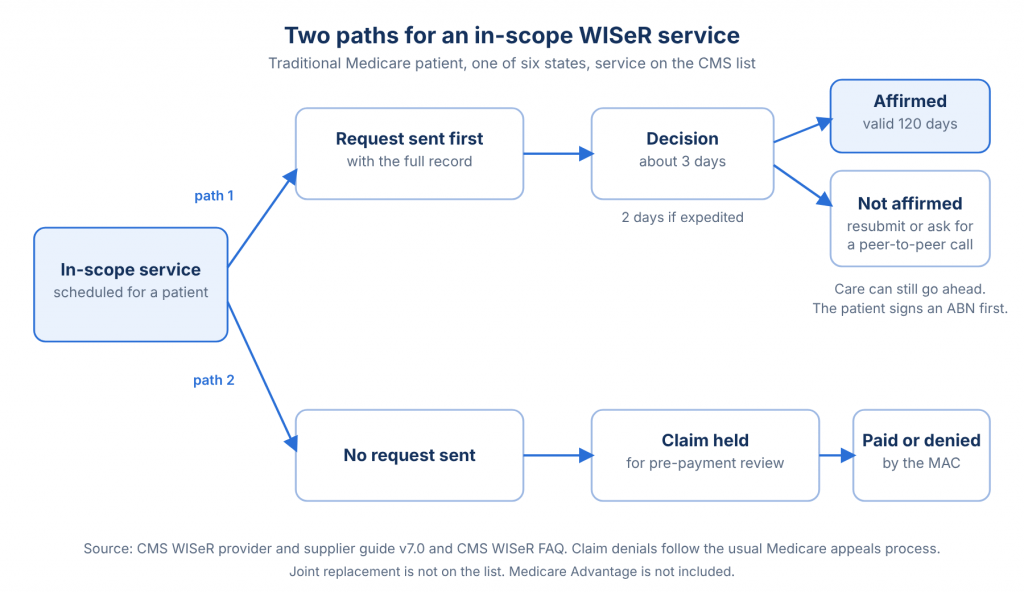
| Path | What happens | Timing |
|---|---|---|
| Prior authorization before the service | The practice sends a request, with its documentation, to the review company for its state or to the Medicare Administrative Contractor (MAC). Submission is by portal, esMD, fax or mail. | A standard decision typically comes within 3 calendar days of the request. CMS notes that requests sent through the MAC or by mail can take longer, while portal requests carry a 72-hour turnaround requirement. An expedited decision comes within 2 days, and only when delay could seriously jeopardize the patient’s life or health. An affirmation is valid for 120 days. |
| Pre-payment review after the service | If no request was sent, the MAC suspends the claim and forwards it to the review company. | Applies to services on or after Jan 15, 2026. Related codes are paid only if the main code was affirmed. |
A request that is not affirmed does not stop care. CMS says the practice can still furnish the service and submit the claim. The practice would give the patient an Advance Beneficiary Notice of Non-Coverage first. It can resubmit as often as needed, and it can ask for a peer-to-peer conversation with a resubmission. A later claim denial from the MAC follows the usual Medicare appeals process.
What reviewers need to see in the record
CMS asks that each request “include all documentation necessary to show compliance with applicable Medicare coverage criteria.” Those criteria sit in national and local coverage determinations. Local ones are written by each MAC, so a group in Ohio and a group in Texas can face different record requirements for the same code.
Epidural steroid injections show how specific the record can be. One MAC’s published policy for Arizona and Washington (Noridian, LCD L39240) lists these items.
| Record element | What the policy asks for |
|---|---|
| Diagnosis | History, exam, and matching imaging that support radicular pain from a listed cause. |
| Severity | Symptoms that greatly affect quality of life or function, with a pain or function scale recorded at baseline. |
| Conservative care | Pain lasting at least 4 weeks, with documented failure of non-invasive care for 4 weeks or inability to tolerate it. |
| Technique | CT or fluoroscopy guidance with contrast, unless a documented allergy applies. |
| Repeat injections | A first injection with at least 50% sustained improvement, measured on the same scale. |
The lesson for any service in the list is the same. The facts reviewers look for are often already in the chart, but spread across notes, imaging reports, and therapy records. A request goes faster when one person or one tool can gather them in a single packet.
Coverage rules also differ by state, because each state has its own MAC. For epidural steroid injections, the policy in force today maps like this.
| State | Part B MAC | Epidural injection policy |
|---|---|---|
| Texas | Novitas Solutions (JH) | L36920 |
| Oklahoma | Novitas Solutions (JH) | L36920 |
| New Jersey | Novitas Solutions (JL) | L36920 |
| Ohio | CGS Administrators (J15) | L39015 |
| Arizona | Noridian Healthcare Solutions (JF) | L39240 |
| Washington | Noridian Healthcare Solutions (JF) | L39240 |
A group with sites in more than one state would need one record checklist per MAC policy, not one for the whole group.
A worked example
Consider a traditional Medicare patient in Arizona with lumbar radicular pain who has finished four weeks of physical therapy. The scheduler sees code 62323 on the order. The system flags that the code is on the list and the patient is in a WISeR state. It checks the surgeon’s NPI and finds no exemption.
The coordinator assembles the MRI report, the baseline pain score, the therapy notes, and the contrast guidance plan into one packet, and submits it through the portal on a Monday. A decision is expected within about three days. The procedure is booked only after the affirmation arrives and within the 120-day window. If the request is not affirmed, the team adds the missing note and resubmits, or asks for a peer-to-peer call.
This is an illustration, not a clinical protocol. Each practice’s own clinicians decide what the record must show.
Exemption: track it at the individual NPI level
Since July 2026, CMS and the review companies have run an exemption program, often called gold carding. A provider who is exempt is generally not subject to prior authorization or pre-payment review for the selected services.
- Eligibility: at least 10 prior authorization requests across the selected services, and an affirmation rate above a threshold. Each review company sets its own threshold, at 90% or lower.
- Level: the individual provider’s NPI, not the group. It covers Part A and Part B in all sites of care.
- Duration: at least one calendar year. Review companies re-evaluate providers each quarter and notify them before the quarter begins.
This turns exemption into a tracking task for every provider. A group with six surgeons could have three exempt and three not, and a new hire starts without a history. A practice would need to know, for each NPI, whether to send a request or skip it.
What the software around an orthopedic practice would need to do
The model does not ask vendors to build anything. But practices will run it through the systems they already use, so EHR, practice management, and prior authorization tools serving orthopedic groups would need to carry the extra work. Six capabilities would cover most of it.
- Scope check at order entry. Flag a scheduled service when three things line up: the code is on the list, the patient has traditional Medicare, and the patient lives in one of the six states. Rules would need to be data, not hard-coded, because CMS can change the list.
- Exemption lookup by NPI. Hold each provider’s status and its re-evaluation date. Skip the request when the provider is exempt, and prompt for one when status lapses.
- Request packet assembly. Pull the diagnosis, imaging report, functional scale scores and conservative care history into one packet, matched to the coverage criteria for the practice’s MAC.
- Routing and submission. Send the packet to the right review company or MAC through the portal, esMD, or fax, and record what was sent and when.
- Clock and expiry tracking. Show the 3-day and 2-day decision windows, the 120-day life of an affirmation, and the scheduled date of service, so a procedure is not booked past an affirmation that has lapsed.
- Denial and appeal tracking. Log each non-affirmation, the resubmission or peer-to-peer step, and any later claim denial, with the reason code kept for review.
None of this requires a new kind of system. Most of it is workflow and data design on top of what a practice already has. The harder part is keeping the rules current, which is why a data-driven rule set matters more than any single screen.
For the health plan side of the same workflow, see our guide to prior authorization automation for health plans.
What to do in the next 30 days
- Size the exposure. Pull 12 months of traditional Medicare claims in the six states for the listed codes, by surgeon.
- Check exemption status for every NPI. Ask each review company for the current status and the next re-evaluation date.
- Write the record checklist per MAC. Have a clinician turn each coverage policy into a short list of what the chart must show.
- Name an owner and a route. Decide who submits, through which portal or channel, and who watches the decision clock.
- Set up tracking. Log every request, decision, resubmission, and claim denial, with reasons.
- Agree on scope with your software partners. Decide which of the six capabilities the EHR, practice management, or prior authorization tool already covers.
- Plan a review after Dec 11. The funding outcome may change the picture, so schedule a check once Congress acts.
Where the debate stands
Both sides raise points worth hearing. CMS describes the model as a way to reduce services it considers wasteful or inappropriate, and it reports that decisions typically return within three days.
Critics focus on two things. The first is the payment design, since review companies earn a share of averted spending. The second is process, because GAO found that the model is a rule, which opened the congressional vote described above.
The American Academy of Orthopaedic Surgeons raised its own concerns in a November 2025 interview. Its advocacy leader said the group was not at the table when the model was shaped. AAOS asked for a later start, for an exemption path for physicians with strong records, and for advance approvals that would be binding. CMS has since launched an exemption program, which relates to the second request. As of this date, this guide found no published denial or overturn figures from CMS, so it is too early to say how often reviews change care.
How Nalashaa helps
Orthopedic groups and the vendors that serve them often ask the same practical question: how do we get the right record to the right reviewer on time? Our healthcare automation services team designs and builds workflows that gather clinical documentation, route requests, track decision windows, and log outcomes, working with the EHR and practice management systems already in place.
WISeR will keep shifting between now and the December funding decisions, but the work it asks of an orthopedic practice stays steady. Know which services are in scope, know which providers are exempt, and get a complete record to the reviewer inside the decision window. Groups and vendors that build that workflow now will be ready whichever way Congress decides, and the same workflow will help with any prior authorization rules that follow. If you are planning that work, write to us at info@nalashaa.com, or use the button below to start a conversation with our team.
FAQ
What is the WISeR model in Medicare?
It is a CMS Innovation Center model that adds prior authorization for selected services in traditional Medicare. Technology companies review requests, with licensed clinicians involved. It runs from 2026 through 2031 and does not apply to Medicare Advantage.
Which states are in the WISeR prior authorization model?
New Jersey, Ohio, Oklahoma, Texas, Arizona, and Washington. A practice with patients in other states is not affected unless it also treats Medicare patients in one of these six.
Which orthopedic procedures are included in 2026?
Knee arthroscopy for osteoarthritis, epidural steroid injections, cervical fusion, vertebral augmentation, and one nerve stimulator code. Joint replacement is not included in the model. Check Appendix A of the CMS provider guide for the current code list.
What does WISeR stand for?
WISeR stands for Wasteful and Inappropriate Service Reduction, the name CMS gave the model.

Latest posts by Priti Prabha (see all)
- WISeR Model: What AI Prior Authorization Means for Orthopedic Practices - November 20, 2026